

Retirement Planning for Pre-Retirees and Retirees in Boston, MA
You Bring the Vision. We Help Build the Plan.
Whether you’re ready to retire or just getting close, we help make sure the pieces fit.
Evergreen Wealth Management is a flat-fee, fiduciary retirement planning firm in Boston, MA, serving pre-retirees and retirees with $1,000,000 or more in investable assets. Led by Nick Stevens, CFP®, with 20 years as a financial advisor including 12 at Fidelity Investments, Evergreen builds comprehensive retirement income plans that integrate Social Security timing, tax-efficient withdrawals, Medicare coordination, and ongoing investment management — all for a flat fee of $900 per month. We meet clients in person in Boston (399 Boylston St) and at coworking locations in Burlington, Needham, and Framingham, and serve retirees nationwide via Zoom.
Income & withdrawal →
Where your paycheck comes from in retirement.
Social Security timing →
When to claim, and what it means for taxes.
Tax planning →
Roth conversions, withdrawal sequencing, IRMAA.
Investment management →
Sequence-of-returns risk in retirement.
Medicare & estate →
Healthcare timing and beneficiary coordination.
$900
PER MONTH, FLAT FEE
$1M
ASSET MINIMUM
20+
YEARS AS A FINANCIAL ADVISOR
100%
FIDUCIARY, FEE-ONLY

What comprehensive retirement planning covers
The transition from accumulation to distribution is the most consequential financial shift most people make. The questions change. “How do I save more?” becomes “How do I make this last?” and “How do I pay the least tax over the next 30 years?”
A comprehensive retirement plan at Evergreen covers retirement income strategy (turning savings into a paycheck), withdrawal sequencing (which accounts to draw from first, and why), Social Security optimization including spousal coordination, Roth conversion analysis modeled across multiple years and tax brackets, tax planning across retirement decades, Medicare and IRMAA planning, estate planning coordination, long-term care considerations, and ongoing investment management custodied at Charles Schwab. Each piece interacts with the others. That is the whole point of a unified plan.
How much do you need to retire?
The “magic number” question is the wrong question. Two retirees with the same $1.5 million can have wildly different outcomes depending on their spending, their tax situation, when they take Social Security, and the sequence of returns they happen to retire into.
A more useful frame: what does your retirement actually look like, and what does it cost? Once you know that, you can work backward — accounting for inflation, healthcare, taxes, and longevity — to a portfolio target that holds up across realistic scenarios.
For most Massachusetts couples, the comfortable-retirement number falls somewhere between $1.2M and $2.5M, but the spread depends heavily on cost of living and lifestyle. A retiree in Newton with a paid-off house and modest spending may need significantly less than a couple in the same town who plan to travel internationally three months a year.
For a deeper walkthrough including specific dollar scenarios, see How Much Do I Need to Retire? Real Numbers, Not Rules of Thumb.

Building your retirement income plan
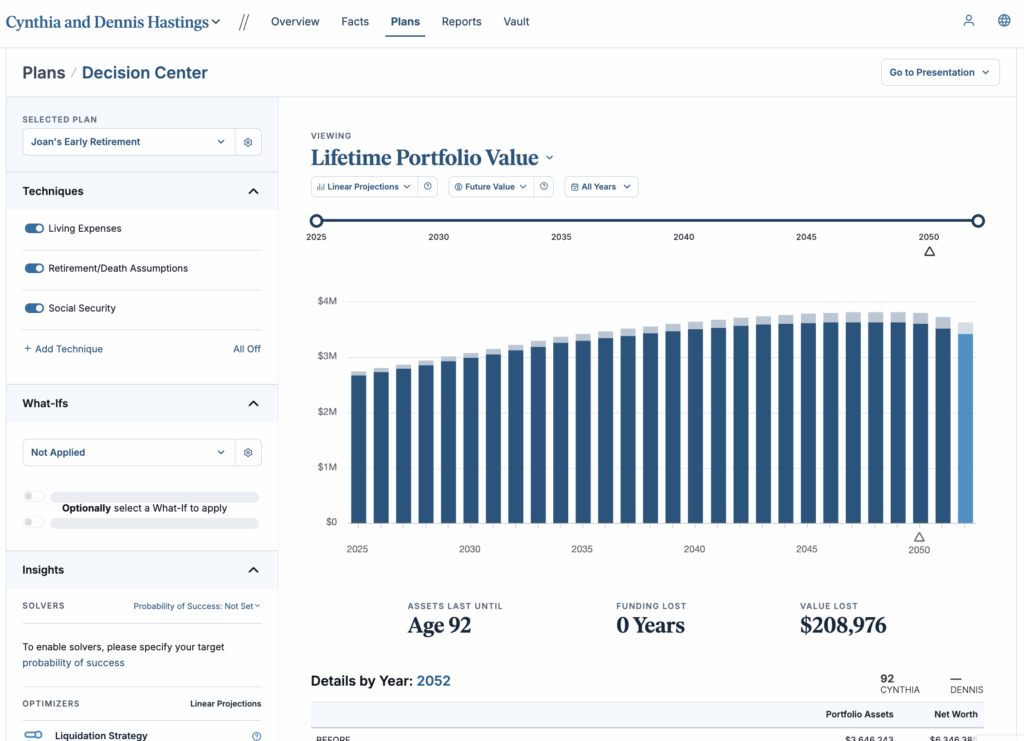
A retirement income plan is the answer to “where will my paycheck come from each month after I stop working?” At Evergreen, we build that plan in eMoney — a financial planning platform used by major RIAs — and stress-test it against the things that actually break retirement plans: inflation (both general and healthcare-specific), market downturns early in retirement (sequence of returns risk), longevity beyond the 30-year planning horizon most calculators use, and unexpected expenses like long-term care, family obligations, and home repairs.
The 4% rule is a useful starting point but increasingly outdated for today’s retirees. We use a dynamic withdrawal approach with guardrails — meaning your safe spending level adjusts based on how the portfolio performs, allowing you to spend more in good markets and modestly less in bad ones. For a deeper look, see The 4% Rule Is Outdated. Here Is What Actually Works.
We use eMoney Advisor to map out your retirement income plan in real terms — comparing options, weighing trade-offs, and giving you a visual you can actually understand. The goal is for you to see exactly where each dollar comes from, year by year.
Investment management built for retirement
Retirement investing is different from accumulation investing. The goal shifts from maximizing growth to balancing growth, income, downside protection, and tax efficiency. The portfolio has to deliver paychecks even when markets are uncooperative.
Evergreen’s investment approach is low-cost and index-based, custodied at Charles Schwab. Portfolios are tax-aware — meaning we manage location decisions (which holdings sit in IRAs vs. taxable accounts), capital gains harvesting, and tax-loss harvesting as part of the management process, not as a separate exercise.
Already have a portfolio you want to keep? Many retiring clients come to us with concentrated stock positions, individual holdings they are attached to, or legacy accounts they do not want to sell. We can integrate those with the retirement plan rather than forcing a clean break.


Tax planning through retirement
Most retirees pay more lifetime tax than they need to. The reason is that tax planning in the working years focuses on this year’s return, while retirement creates a 20–30 year tax planning horizon where bracket management, timing, and account structure matter enormously.
Roth conversions during the early retirement “tax gap years” (after employment income ends but before Social Security and RMDs begin) can be one of the highest-return planning moves available. We model these across multiple years using Holistiplan to see when they are worth doing.
We also think carefully about withdrawal sequencing — drawing from taxable, tax-deferred, and Roth accounts in the order that minimizes lifetime taxes, not just this year’s. See Tax-Efficient Withdrawals and Roth Conversions in 2025 for specifics.

“In 12 years at Fidelity I watched hundreds of people approach retirement with a portfolio number but no plan. That gap is the most expensive mistake in personal finance. The work isn’t building wealth anymore — it’s converting the wealth you have into the life you want, year after year, in a tax-aware way that actually lasts.”
— Nick Stevens, CFP®
Founder & Sole Advisor, Evergreen Wealth Management

When to take Social Security
For most retirees, Social Security is the largest guaranteed lifetime income source they will ever have. The decision of when to file — anywhere from age 62 to 70 — can swing total lifetime benefits by hundreds of thousands of dollars.
The right timing depends on your health, your spouse’s situation, your other income sources, and how much flexibility you have to delay. There is rarely a single “best” answer, but there is usually a better one given the facts of your situation.
For Massachusetts retirees specifically, where state income tax does not apply to Social Security, the calculus differs from high-tax states. See Social Security Timing for Massachusetts Retirees for the dollar impact across different claiming ages.
Healthcare and estate planning coordination
Two pieces of the retirement puzzle that get overlooked until they are urgent. We coordinate both as part of the standard plan.
Healthcare and Medicare planning
Medicare is a planning event, not just an enrollment task. Get the timing wrong and you can incur lifetime late-enrollment penalties. More commonly, retirees are surprised by IRMAA — the income-related Medicare surcharge that kicks in above certain income thresholds and can add thousands of dollars to annual premiums.
We coordinate Medicare enrollment, IRMAA planning (which interacts heavily with Roth conversion timing), and the broader retirement income plan so the surcharges do not catch you off guard. See Medicare Enrollment: What to Know Before October and Social Security & Medicare Income Planning for more.
Estate planning coordination
Evergreen does not draft estate documents — that is your estate attorney’s job. What we do is coordinate. Beneficiary designations on your retirement accounts override your will, so we make sure those are aligned with your intentions. We work alongside your estate attorney and CPA so the financial plan, the tax plan, and the estate plan all point in the same direction.
For Massachusetts retirees specifically, the state estate tax kicks in at $2 million — much lower than the federal threshold — and there are planning moves that can significantly reduce or eliminate the bite. See Estate Planning in a Changing Landscape.
Frequently asked questions about retirement planning
When should I start retirement planning?
The most common answer is “10 years before retirement” — but the truth is, the ideal time depends on the decisions in front of you. If you’re 50 and starting to think about an early-retirement scenario, modeling now matters. If you’re 60 and your situation is straightforward, 5 years out is fine. If you’re already retired and were never sure your plan was right, it’s not too late — most of our new clients are within 3 years of retirement, in retirement, or recently retired.
How much do I need to retire in Massachusetts?
For most Massachusetts couples, the comfortable-retirement portfolio target falls between $1.2M and $2.5M, but the answer depends on your actual spending, Social Security expected, pension or other income, and the cost of living in your specific town. See our detailed walkthrough at How Much Do I Need to Retire?
What is the difference between a retirement planner and a wealth manager?
“Wealth manager” usually means a firm that focuses on investment management with planning attached. “Retirement planner” usually means a firm that focuses on the comprehensive retirement plan — income, tax, Social Security, Medicare, estate — with investment management as one piece of it. Evergreen is firmly in the second camp. The question we are answering is “how do you make this work for the next 30 years,” not just “how do we manage your investments.”
Does Evergreen handle Medicare and Social Security planning?
Yes. Both are core parts of the comprehensive retirement plan. Medicare timing, IRMAA planning, and the interaction with Roth conversions are all part of the engagement. Social Security timing, including spousal coordination strategies, is too.
Can I keep my existing 401(k) when I retire?
Yes, with caveats. You typically cannot roll over a 401(k) to an IRA while still employed (though some plans allow in-service rollovers after age 59½). After retirement, the rollover decision depends on the 401(k) plan’s investment options, costs, and any unique features (NUA on company stock, age-55 separation rules, creditor protection in certain states). We model this decision case-by-case.
How is the $900/month fee charged?
The fee is automatically deducted monthly from your managed Charles Schwab brokerage account at the beginning of each month. Spouses can split fees between accounts if preferred. There are no long-term contracts — you can end the engagement at any time.
The technology behind every retirement plan
eMoney for income modeling, Holistiplan for tax planning, Nitrogen for risk alignment, Schwab for custody.



Read more on retirement planning
Deep-dives on the decisions that shape a Massachusetts retirement — Social Security timing, withdrawal sequencing, the 4% rule, RMDs, long-term care, and Medicare/IRMAA planning.
How Much Do I Need to Retire in Massachusetts?
MA-specific cost-of-living, healthcare, and tax math behind a realistic retirement number.
How Much Do I Need to Retire? The Real Numbers, Not Rules of Thumb
Why generic rules of thumb mislead, and how to build a number that actually fits your spending.
The 4% Rule Is Outdated. Here Is What Actually Works.
Why the original 4% study no longer fits today’s environment, and what dynamic withdrawal looks like instead.
Social Security Timing for Massachusetts Retirees: The Real Costs of Claiming Early vs. Waiting
The real cost of claiming early vs. waiting — break-even ages, spousal coordination, and MA-specific factors.
Tax-Efficient Withdrawals: Keeping More of Your Retirement Income
Sequencing withdrawals across taxable, tax-deferred, and Roth to lower your lifetime tax bill.
Creating Your Own Paycheck in Retirement: Turning Savings Into Steady Income
How to turn savings into steady income — bucket strategy, withdrawal mechanics, and cash management.
Long-Term Care Could Drain Your Savings. Here Is How to Prepare.
LTC reality check for retirees: costs, coverage options, and how to plan for the scenario nobody wants.
RMDs Explained: When They Start and How to Reduce Them
When required minimum distributions kick in, how they are calculated, and tactics to lower the bite.
Social Security, Medicare & Income Planning: What Retirees Need to Watch
How Social Security, Medicare premiums, and IRMAA brackets interact in your retirement income plan.
Managing Volatility in Retirement
Sequence-of-returns risk, market drawdowns, and currency debasement — how the portfolio holds up.
Is $2 Million Enough to Retire?
What a $2M portfolio actually supports — spending scenarios, taxes, and the variables that change the answer.
Medicare IRMAA Brackets for 2026
The 2026 income thresholds that raise your Medicare premiums, and how to plan withdrawals around them.
Estate Planning in a Changing Landscape: What Retirees Need to Know Now
What retirees should revisit now — beneficiaries, trusts, and the estate tax picture in Massachusetts.
Affiliations & credentials
Independent. Fiduciary. Member of the most established fee-only advisor organizations.





Get started — your free retirement planning consultation
A complimentary 45-minute introductory call to discuss your situation and whether Evergreen is the right fit. No obligation, no sales pitch.