
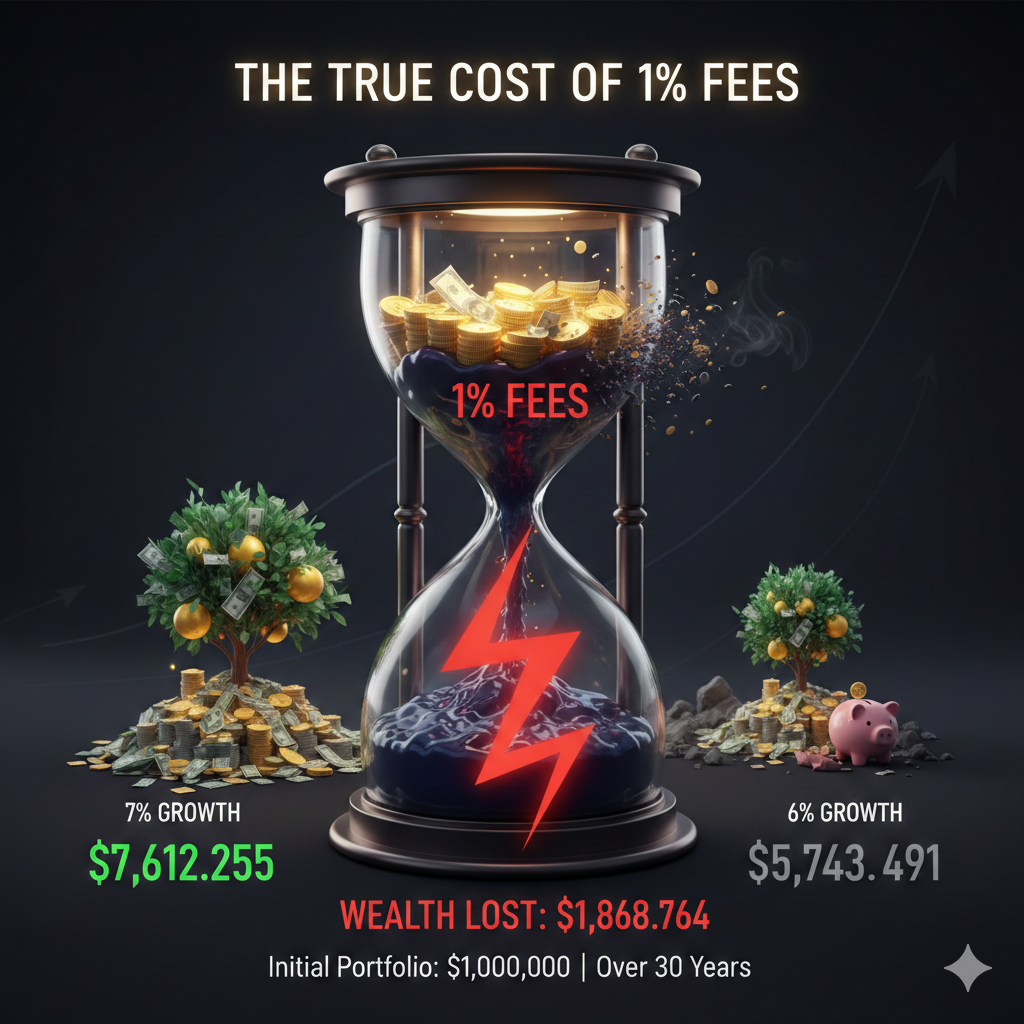
When you interview a financial advisor, a 1% Assets Under Management (AUM) fee sounds small—almost negligible. But in the world of long-term investing, 1% is not just a fee; it is a significant portion of your future spending power.
At Evergreen Wealth Management, we believe in radical fee transparency. To help you make an objective decision, we have modeled the impact of a traditional 1% fee against our $725/month flat fee over a 30-year retirement horizon.
The Problem: Compounding Fee Drag
Most investors understand compounding growth, but few consider compounding fee drag. Because AUM fees are deducted from your balance, they don’t just cost you the cash today—they cost you the future growth that cash would have generated.
Over 30 years, a 1% fee can effectively “tax” your total wealth by 25% or more.
The 30-Year Fee Comparison: Flat-Fee vs. 1% AUM
Below is a mathematical projection for a $1,500,000 portfolio with an average annual return of 7%.
- AUM Model: 1% annual fee (recalculated as the portfolio grows).
- Evergreen Model: $725/month ($8,700/year) flat fee.
| Year | Portfolio Value (7% Return) | Total AUM Fees (Cumulative) | Evergreen Flat-Fees (Cumulative) | The “Savings Gap” |
| Year 1 | $1,500,000 | $15,000 | $8,700 | $6,300 |
| Year 10 | $2,735,221 | $202,345 | $87,000 | $115,345 |
| Year 20 | $5,040,119 | $612,450 | $174,000 | $438,450 |
| Year 30 | $9,343,916 | $1,485,210 | $261,000 | $1,224,210 |
Key Takeaway:
In this scenario, the investor paying a 1% AUM fee paid $1.2 million more in total costs over 30 years. That is money that could have funded travel, a second home, or a larger legacy for heirs.
Impact on Your “Safe Withdrawal Rate” (SWR)
The “4% Rule” is a benchmark for retirement spending. However, your Safe Withdrawal Rate is always gross of fees.
If you have a $1.5M portfolio and you pay a 1% AUM fee, your “Safe” spending is effectively reduced.
- With 1% AUM: To keep your portfolio safe, you might only be able to spend 3.0% of your wealth annually, because the first 1% is already spoken for by your advisor.
- With a Flat Fee: Because your fee is fixed and does not grow with your wealth, your withdrawal rate remains focused almost entirely on your lifestyle, giving you a higher probability of success in long-term retirement.
Tip: When an advisor’s fee is tied to your account balance, they are a “silent partner” in your gains but take no risk in your losses. A flat fee decouples your advice from your portfolio size, protecting your withdrawal rate.
Is the 1% Fee Ever Justified?
To remain objective, it is important to note when the AUM model might make sense:
- Small Portfolios: If you have $200,000, a 1% fee ($2,000) is significantly cheaper than our $8,700 flat fee.
- Extreme Complexity: If you require a multi-family office with in-house private jet coordination and complex international tax attorneys, the labor-heavy AUM model may be appropriate.
- Relationship: If you value the relationship with your advisor more than anything else and they charge 1% then it may be worth it. Having a financial advisor you trust is extremely important, so if this is all that matters to you then it could be justified.
For the typical $1M–$10M retiree, however, the math rarely favors a percentage-based fee. Put another way – A heart surgeon performing a life saving surgery charges a flat-fee for services and not a percentage of ones wealth – why do most financial advisors charge a percentage?